
Genealogy is about so much more than names, dates, and documents. It is about understanding how our ancestors actually lived. What did they grow? What did they eat? How did they prepare their food? What traditions did they hold onto, and what did they pass down to their children?
The enslaved people at Nomini Hall and across Robert Carter III’s plantations brought knowledge, traditions, and cultural practices with them that were rooted in their African heritage. Over generations, those traditions were adapted to life in Virginia’s Northern Neck and Tidewater regions, using the crops, animals, waterways, and other resources available to them.
For me, this is where genealogy becomes personal. These were not just people whose names appear in inventories, deeds, and other records. They were our ancestors living their everyday lives. They planted and harvested food with their own hands. They cooked meals, fished the rivers and creeks, preserved food, fed their children, and found ways to make something out of what little they were given.
Learning about their foodways gives us another way to understand their lives beyond slavery. What they ate, what they grew, how they prepared it, and what they passed down from one generation to the next tells us something important about who they were, how they survived, and the culture they carried forward.
What We Know About Rations at Nomini Hall
One of the most valuable pieces of primary evidence we have about food at Nomini Hall comes directly from the journal of Carter’s tutor Philip Fithian. Writing about the enslaved people on Carter’s estate, Fithian recorded:
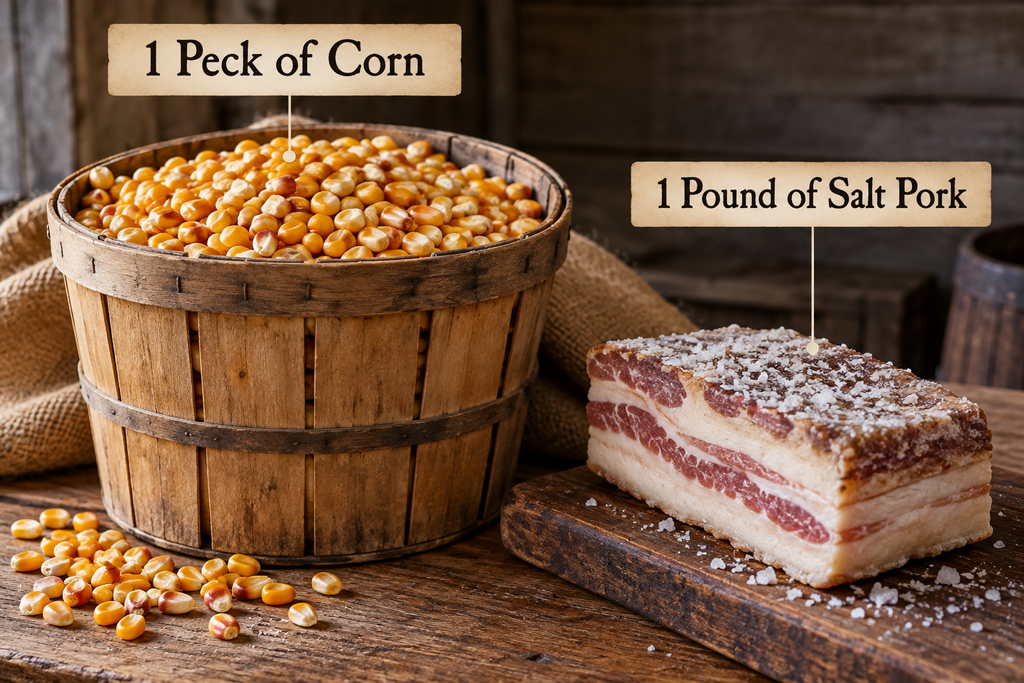
“Their weekly allowance is a peck of Corn, & a pound of Meat a Head!”
He followed this with a telling observation: “And Mr. Carter is allowed by all, & from what I have already seen of others, I make no Doubt at all but he is, by far the most humane to his Slaves of any in these parts! Good God! are these Christians?” (Library of Congress, Fithian manuscript)
The Land and What It Produced
Carter’s plantations sat in Virginia’s Northern Neck, the peninsula between the Potomac and Rappahannock rivers. This tidal region shaped everything about what people ate.
From the water: The Chesapeake Bay and its tributaries provided oysters, crabs, fish (herring, shad, rockfish), and eels. Enslaved people fished both as assigned labor and to supplement their own diets. Archaeological evidence from comparable Chesapeake plantations, including Mount Vernon and Monticello, confirms that fish and shellfish were significant food sources for enslaved communities across the region.
From the fields: Tobacco was the cash crop, but Carter’s plantations also produced corn, wheat, and other provisions. Philip Vickers Fithian, tutor at Nomini Hall in 1773 to 1774, described Carter’s operation as encompassing many plantations, some devoted entirely to producing grain and supplies for the estate (Fithian, Journal and Letters). Enslaved people often maintained their own garden plots where they grew food for their families.
From the woods: Hunting (when permitted or done covertly) provided rabbit, possum, squirrel, and wild turkey. Foraging added nuts, berries, and wild greens to the diet. These were not luxuries. They were survival strategies inside a system that provided the bare minimum and expected maximum labor in return.
Think about that. A peck of corn, roughly eight quarts of dried grain, and one pound of meat per person, per week. And Fithian considered Carter generous compared to neighboring slaveholders.
This was not a diet designed for health. It was designed for economy. A peck of corn could be ground into meal and stretched across the week as hoecakes, mush, or porridge. A pound of meat, typically salt pork or occasionally salted fish, added fat and some protein but little real nutritional value. Jane Carson’s Colonial Williamsburg research on Nomini Hall’s household confirms that enslaved house servants received “the regular weekly ration of a peck of corn, a pint of salt, and a pound of meat,” supplemented by vegetables and poultry they raised themselves and likely by leftovers from the Carter table (Carson, Plantation Housekeeping in Colonial Virginia).
Meanwhile, the Carter family ate well. Fithian’s journal describes a household table supplied with ham, beef, oysters, crabs, various breads, cider, and imported goods. The gap between the planter’s table and the enslaved community’s provisions is itself a piece of evidence. It tells us exactly where the priorities of the system lay.
The ration was not standardized and was not guaranteed. It varied by plantation, by overseer, by season, and by the slaveholder’s finances. Across Carter’s properties, which spanned thousands of acres in Westmoreland, Richmond, Northumberland, Frederick, Loudoun, and Prince William counties, the daily reality for each enslaved person depended on which overseer managed their particular quarter. Regional records from comparable Virginia plantations confirm the pattern: at Monticello, Thomas Jefferson’s enslaved workers received a peck of cornmeal, a half-pound of pork or pickled beef, and four salted fish per week (Sawyer and Bowen, Slave Provisioning at Monticello). At Mount Vernon, enslaved people received one quart of cornmeal per day and salted fish, and George Washington himself acknowledged that the amount was sometimes not enough (Mount Vernon, Food).
There was no oversight or standard. There was only what the overseer decided to give.
How the Enslaved Fed Themselves
The ration was never the whole story. Enslaved people across Virginia found ways to feed themselves and their families beyond what the plantation provided. These efforts required ingenuity, labor after an already exhausting workday, and sometimes real personal risk.
Garden Plots. Many enslaved individuals cultivated small patches of land, growing vegetables, herbs, and sometimes crops they could trade. These gardens were tended on Sundays or in the few hours between the end of field work and nightfall. They provided greens, beans, sweet potatoes, cowpeas, and other produce that filled the nutritional gaps left by the standard ration. More than that, gardens gave enslaved people a measure of autonomy: the ability to decide what to grow, what to eat, and what to share. At Gunston Hall, a neighboring Northern Neck plantation, historical markers confirm a similar ration of a peck of corn and a pound of meat, noting that “some enslaved people also added variety to their diet” through poultry, shellfish, and personal gardens. The pattern was regional and deeply rooted.
Fishing and Shellfish. In the Northern Neck, the Potomac and Rappahannock rivers and their tributaries offered access to herring, shad, crabs, oysters, and other aquatic foods. Archaeological evidence from Mount Vernon’s House for Families shows that enslaved people consumed a wide variety of fish species, many of which were caught independently rather than issued as rations. The same rivers ran past Carter’s properties.
Hunting and Foraging. Enslaved men sometimes hunted small game or foraged for wild plants, nuts, and berries. These activities carried risk: being found away from the plantation without permission could mean punishment. But the need to feed a family often outweighed the danger.
Community and Sharing. Food was shared. Meals were communal. Enslaved communities looked out for one another, pooling resources and trading what they had. Tom Gumby, one of the oldest enslaved people at Nomini Hall, shared eggs, watermelons, and other produce from his garden with Fithian in 1774 (Foundation for Historic Christ Church, Gumby panel). That small detail tells us that even the elderly were growing food, sharing food, and maintaining relationships through food. This mutual reliance was not just survival. It was the preservation of dignity in a system designed to strip it away.
African Food Traditions in Virginia
The enslaved community at Nomini Hall carried agricultural and culinary knowledge from West and Central Africa. These traditions survived and adapted in Virginia soil.
One-pot cooking. Stews, soups, and slow-cooked dishes made with whatever was available. This method stretched limited ingredients, used minimal fuel, and fed households efficiently. The tradition runs directly from West African cooking to what we now call Southern comfort food. Culinary historian Michael W. Twitty traces these connections in The Cooking Gene, documenting how enslaved cooks created what he calls “edible jazz” from their impoverished pantries.
Okra, black-eyed peas, and leafy greens. These crops are African in origin. Okra was cultivated in West and Central Africa for centuries before it crossed the Atlantic; scholars trace its arrival in the American South to the slave trade of the 1700s (Plant Humanities Lab, Okra). The cowpea, or black-eyed pea, was domesticated in tropical West Africa more than 6,000 years ago and became a fixture in enslaved people’s gardens and cooking pots across the South (Plant Humanities Lab, Black-Eyed Pea). Judith Carney and Richard Rosomoff’s In the Shadow of Slavery documents how enslaved Africans turned their food plots into what Carney calls “botanical gardens of the dispossessed,” growing the crops that sustained both body and cultural memory. These foods were almost certainly grown in personal garden plots at Nomini Hall and across Carter’s properties.
Corn as a staple. Cornbread, hominy, cornmeal mush, hoecakes, and ash cakes were daily sustenance. Enslaved cooks transformed this basic ration into dozens of preparations. A hoecake cooked on a blade over an open fire is not just food. It is technique, memory, and tradition compressed into a single act.
Preservation techniques. Smoking, salting, and drying meats and fish. Pickling and preserving vegetables for winter. These skills were essential for survival and were passed through generations.
Rice. While Virginia was not a major rice colony like South Carolina, enslaved people with rice-growing knowledge influenced how grains were prepared and consumed throughout the region. Twitty documents the Senegambian influence on Chesapeake foodways specifically, noting the deep connections between West African rice culture and Virginia cooking traditions (The Cooking Gene).
What Inadequate Nutrition Did to Their Bodies
A diet built almost entirely on cornmeal and salt pork was a recipe for chronic illness. Corn provides calories but is deficient in niacin and several essential vitamins when it makes up the bulk of the diet. Salt pork adds fat but little else. Without consistent access to fresh vegetables, fruits, and varied protein, enslaved people faced serious health risks.
Todd L. Savitt’s Medicine and Slavery, the definitive study of Black health in antebellum Virginia, documents the widespread nutritional consequences of this system. Kenneth Kiple and Virginia King’s Another Dimension to the Black Diaspora (Cambridge University Press, 1981) further details how the standard slave diet left enslaved people vulnerable to deficiency diseases, weakened immune systems, bone deformities, skin conditions, eye problems, and dental deterioration. Descriptions of runaway slaves are filled with references to crooked legs, splotchy skin, inflamed eyes, and rotten teeth, all indicators of chronic nutritional deficiency.
Weakened immune systems left enslaved people vulnerable to infections, fevers, and diseases that swept through crowded living quarters. Children suffered disproportionately: stunted growth, higher infant mortality, and developmental problems were direct consequences of chronic malnutrition during the most critical years of life.
These were not isolated health problems. They were systemic outcomes of a system that treated human beings as expendable labor. The physical toll of slavery did not end with emancipation. It echoed through generations, shaping health outcomes in descendant communities for decades. Understanding this history is part of understanding why food access and health equity remain urgent issues in Black communities today.
How Slaveholders Used Food as Power
Food was never just food on a plantation. It was leverage.
Slaveholders and overseers controlled every aspect of food distribution, and they used that control deliberately. Rations could be increased as a reward for compliance or decreased as punishment. Withholding food was a documented disciplinary measure on plantations throughout Virginia. The economics were straightforward: feeding the enslaved was a cost, and slaveholders sought to minimize it. Providing the cheapest, most basic provisions kept expenses low while maintaining just enough energy in the workforce to keep the plantation running.
This dynamic, where the person who controls the food controls the people, was one of the most insidious mechanisms of slavery. It reinforced dependence, punished independence, and made the simple act of growing your own food a form of quiet rebellion.
And yet our ancestors grew those gardens anyway. They fished those rivers. They shared what they had. They fed their families. Every seed planted in a personal plot was an act of resistance against a system that wanted to reduce human beings to a line item on a ledger.
Post-Emancipation Foodways
After freedom, the formerly enslaved people of Nomini Hall carried their food knowledge into new lives. Many remained in the Northern Neck region as tenant farmers or landowners, continuing to work the same land but now for themselves.
Food traditions that survived emancipation:
Church dinners and community gatherings. Food as the center of Black community life. Sunday dinners, homecomings, and fellowship meals.
Seasonal traditions. Hog killing in late fall. Spring fishing runs. Summer gardens. Preserving for winter. These rhythms connected freed people to agricultural knowledge passed down from enslavement and before.
Holiday foods. Specific dishes tied to celebrations, many with roots in both African tradition and the adaptations made during enslavement. The black-eyed peas eaten on New Year’s Day for good luck trace directly to West African cowpea traditions carried through the Middle Passage and preserved across generations (Plant Humanities Lab, Black-Eyed Pea).
Healing foods and remedies. Herbal teas, tonics, and food-as-medicine traditions passed from generation to generation. Root knowledge that blended African botanical traditions with knowledge of local Virginia plants.
Cultural Traditions Beyond Food
Naming practices. The names recorded in Carter’s Deed of Gift and in Barden’s dissertation research are evidence of family connection, identity, and in some cases, African naming traditions. The Deed lists people by name, age, sex, family relationship, and plantation location, preserving details that connect descendants to specific ancestors.
Music and worship. Baptist faith was strong among the enslaved community, and Carter’s own conversion to evangelical Christianity, and later to Swedenborgianism, was influenced by his interactions with Black worship (Encyclopedia Virginia, Robert Carter III). Hymns, spirituals, and worship practices carried African musical traditions into American Christianity and became foundational to Black church culture in the Northern Neck.
Skilled trades. The Deed of Gift and plantation records reference enslaved people with specific skills: carpenters, blacksmiths, coopers, weavers, seamstresses, millers, bakers, tanners, shoemakers, and sailors. Carson’s Colonial Williamsburg research identifies at least 26 adult house servants and numerous skilled tradespeople at Nomini Hall alone (Carson, Plantation Housekeeping). These trades became economic foundations after freedom.
Burial traditions. How the community honored their dead, the location of burial grounds, and the practices surrounding death and mourning. Some traditions blended African, Christian, and local customs.
Storytelling and oral history. In a community where literacy was legally restricted, oral tradition was everything. Stories, genealogies, warnings, and wisdom passed by word of mouth. Some of that oral history survives in family traditions today. Every story a descendant carries is a piece of the archive.
Recipes and Oral Traditions
This section will grow as descendants contribute family recipes and food memories.
We invite descendants of the Nomini Hall community to share:
- Family recipes passed down through generations
- Food memories and traditions from older relatives
- Stories about holiday meals, Sunday dinners, and special occasion foods
- Knowledge of home remedies and healing foods
- Gardening traditions and seed-saving practices
- Names of family cooks, gardeners, farmers, and food providers
Every recipe is a document. Every food memory is evidence of survival, creativity, and love passing through generations. When you share a recipe, tell us who taught it to you, where they lived, when it was prepared, and what it meant to your family. That context turns a recipe into a genealogical source.
Preserving What Remains
Every year, living memory fades. Elders who remember the old ways, the old recipes, the old stories are passing. This page is a call to action.
If you are a descendant of the Nomini Hall community and you carry food traditions, cultural practices, or oral histories from your family, we want to hear from you. Your grandmother’s recipe is a historical document. Your family’s way of celebrating holidays is evidence of cultural survival across centuries.
Contact us to contribute to this growing archive.
Sources
Harold Caldwell, “An Introduction to Early African American Foodways Interpretation,” Afroculinaria.
Philip Vickers Fithian, Journal and Letters of Philip Vickers Fithian, 1773-1774. Library of Congress manuscript. Full text: Project Gutenberg.
Robert Carter III, Deed of Gift, August 1, 1791. Encyclopedia Virginia transcription.
Andrew Levy et al., “Robert Carter III Deed of Gift,” Journal of Slavery and Data Preservation, 2024. Peer-reviewed dataset article.
John Randolph Barden, Flushed with Notions of Freedom: The Growth and Emancipation of a Virginia Slave Community, 1732-1812 (Ph.D. dissertation, Duke University, 1993). Dissertation record. Available through the Foundation for Historic Christ Church.
Andrew Levy, The First Emancipator: Slavery, Religion, and the Quiet Revolution of Robert Carter (Random House, 2005). Publisher page.
Jane Carson, Plantation Housekeeping in Colonial Virginia (Colonial Williamsburg Research Report). Colonial Williamsburg Digital Library.
Brendan Wolfe, “Robert Carter III’s Deed of Gift,” Encyclopedia Virginia.
John R. Barden, “Robert Carter (1728-1804),” Encyclopedia Virginia.
Todd L. Savitt, Medicine and Slavery: The Diseases and Health Care of Blacks in Antebellum Virginia (University of Illinois Press, 1978; reissued 2002). Publisher page.
Kenneth F. Kiple and Virginia Himmelsteib King, Another Dimension to the Black Diaspora: Diet, Disease, and Racism (Cambridge University Press, 1981).
Michael W. Twitty, The Cooking Gene: A Journey Through African American Culinary History in the Old South (Amistad/HarperCollins, 2017). Author’s project.
Judith A. Carney and Richard Nicholas Rosomoff, In the Shadow of Slavery: Africa’s Botanical Legacy in the Atlantic World (University of California Press, 2009). Publisher page.
Dumbarton Oaks Plant Humanities Lab, “Black-Eyed Pea: Crop, Culture, Class.” Plant Humanities Lab.
Dumbarton Oaks Plant Humanities Lab, “Okra: An Enduring Kitchen Staple.” Plant Humanities Lab.
George Washington’s Mount Vernon, “Food.” Mount Vernon.
George Washington’s Mount Vernon, “House for Enslaved Families.” Mount Vernon Digital Encyclopedia.
Elizabeth C. Sawyer and Joanne Bowen, “Slave Provisioning at Monticello.” DAACS PDF.
Georgetown Slavery Archive, “One Peck of Meal: Food Rations and Social Conditions at St. Inigoes, The Mobberly Diaries.” Georgetown Slavery Archive.
Foundation for Historic Christ Church, Tom Gumby exhibit panel. PDF.