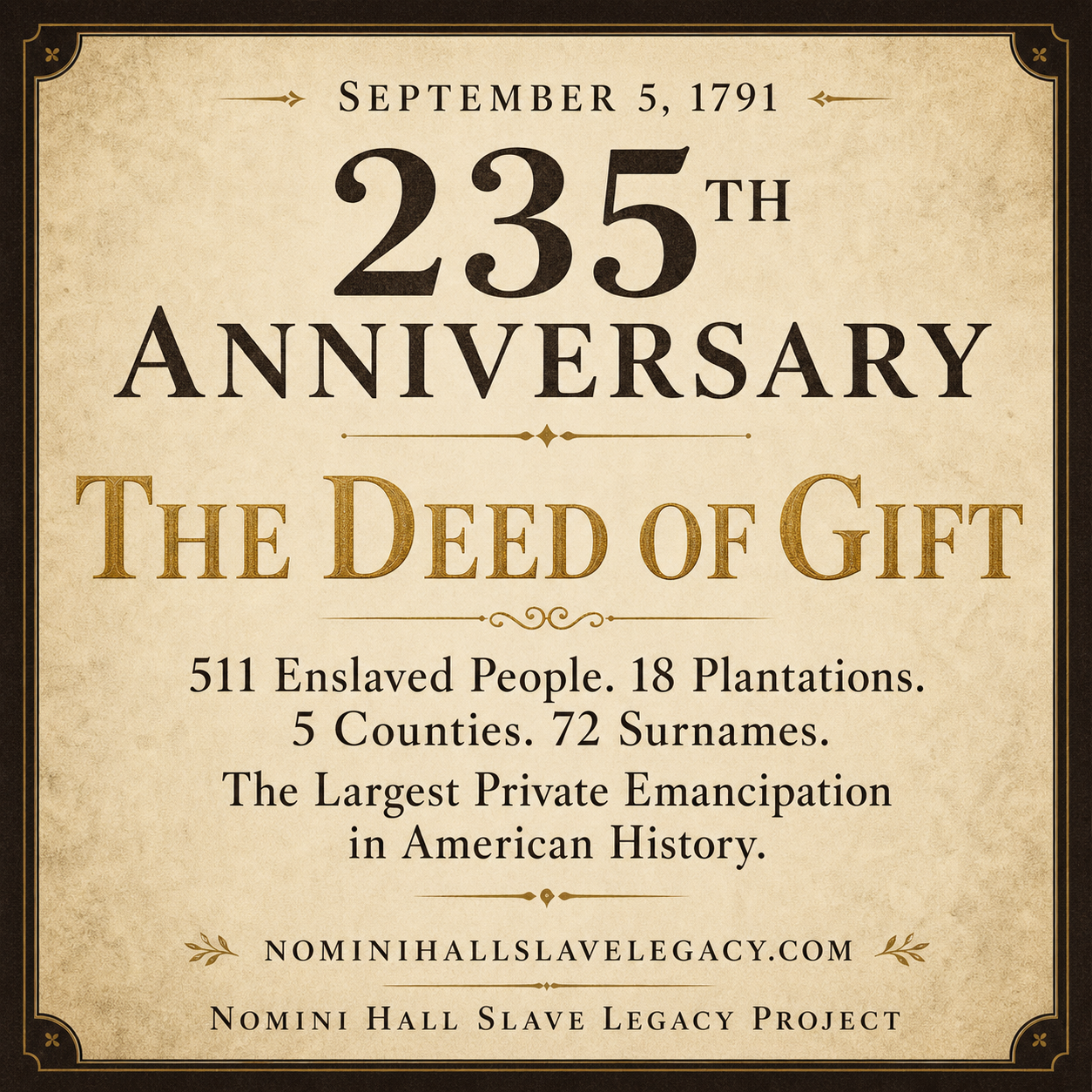
On September 5, 1791, Robert Carter III walked into the Northumberland County District Court in Virginia and filed a document he called the Deed of Gift. It set in motion the gradual emancipation of 511 enslaved men, women, and children held across 18 plantations in five Virginia counties, from the Northern Neck peninsula to the Shenandoah Valley.
It was the largest act of private emancipation in United States history before the Civil War. And most Americans have never heard of it.
Today marks 235 years since that filing. This is not a story about Robert Carter. It is a story about 511 people, the freedom they claimed, and the thousands of descendants who carry their legacy today.
The Scale
In 1791, the total enslaved population of Virginia was approximately 292,000. Carter freed more people than lived in most Virginia towns. His contemporaries and acquaintances in Virginia’s ruling elite, George Washington freed 123 enslaved people in his will, Thomas Jefferson freed 10 in his lifetime. Carter freed more than 500 while he was alive, healthy, and deliberate. He spent years planning. He faced resistance from his neighbors, his family, and the legal system. And he persisted. Carter moved in the same rooms as the Founding Fathers but is buried in an unmarked grave while they got monuments.
But his Deed did not free anyone by itself. People freed themselves, one courtroom appearance at a time. The Deed of Gift was the legal mechanism, but it didn’t automatically make anyone free. Each person still had to physically go to a county court, present their certificate, and have their freedom officially recorded. Every one of them had to stand before a judge who controlled their fate. The Deed created the legal pathway, but the people themselves had to walk through it.
The People
The Deed listed 511 individuals by name, age, and plantation. They were mothers, fathers, children, blacksmiths, cooks, farmers, seamstresses, carpenters, coopers, shoemakers, tanners, tailors, hatters, bricklayers, weavers, spinners, millers, bakers, sailors, chambermaids, laundresses, nurses, waiting men, barbers, field laborers, carters, hostlers, and gardeners. They had families, skills, knowledge, and traditions rooted in West African heritage and shaped by the Virginia landscape. They were not a footnote. They were a community.
When they were freed, they chose their own surnames: Allen. Arnold. Bacon. Bailey. Banks. Brooke. Brown. Brutus. Burke. Burton. Carey. Cary. Colson. Conway. Cooper. Craft. Dailey. Daly. Daniel. Debo. Dial. Dicher. Dickson. Dixon. Gaskins. Glascock. Glasscock. Greggs. Griggs. Gumby. Hackney. Harris. Harrison. Henry. Hollady. Horris. Hubbard. Johnson. Johnston. Jones. Jordan. Kenardy. Miller. Mitchell. Newgent. Newman. Peterson. Puss. Reed. Reid. Richards. Richardson. Robinson. Single. Smith. Spence. Taylor. Thomas. Thompson. Thornton. Thorton. Tosspot. Trustin. Tuckson. Walker. Weldon. Wells. Wilson. Wormley. Worsley. Wyatt.
Not one of them chose the name Carter. Every name selection was an act of self-determination. Every name said: I belong to myself.
The Fight for Freedom
Freedom under the Deed was not instant and it was not easy. The emancipation was gradual, designed to unfold over decades. Carter structured the schedule by age: fifteen of the oldest adults were freed first, on January 2, 1792. Another fifteen were freed on January 1, 1793, and fifteen more every January after that through 1801. Males under twenty-one would not be freed until they reached that age. Females under eighteen would not be freed until they turned eighteen. Children born to enslaved mothers after the Deed was filed were still born into slavery and would not receive their freedom until adulthood.
That means a child born at Nomini Hall in 1792, one year after the Deed was signed, would not be free until 1813 at the earliest. For over two decades, people lived in bondage with a promise of freedom on paper but not yet in hand.
The legal process itself was grueling. Virginia’s 1782 Manumission Act required that each person’s freedom be individually recorded in a county court. There was no single moment of liberation. Freedom came one certificate at a time, one courtroom at a time, across five counties. Each person had to appear before a judge, present documentation, and have their status officially changed from enslaved to free.
When Carter moved to Baltimore in 1793, he placed the remaining manumissions in the hands of a trustee, the Baptist minister Benjamin Dawson. After Carter’s death in 1804, his own family challenged the Deed in court, attempting to block the remaining emancipations. Some manumissions were delayed for years. The Frederick District Court refused at least one, denying freedom to Sally Harrison, who had been scheduled for manumission in 1805. It was not until the Virginia Court of Appeals upheld the Deed in 1808 that the legal challenges were finally defeated.
The last recorded freedom certification was not completed until 1839, when Jesse Burke was certified free in Fairfax County, 48 years after the Deed was filed and long after Carter was buried in an unmarked grave at Nomini Hall.
Each person had to appear before a county court and claim their freedom with a certificate in hand. One surviving certificate reads:
“Dennis Johnston, a Male Negro aged about twenty seven years of dark Complexion five feet ten or eleven inches, stout and well made liberated By Benjamen Dawson, trustee for Robert Carter by Deed dated the 3rd day of November 1799, and duly recorded in the County Court of Frederick.”
White neighbors fought the manumissions. They feared free Black people would destabilize the slave system. They resented that freed families were renting land, building lives, taking up space. After Carter’s death in 1804, his own family contested the Deed in court. Some manumissions were delayed for years. Virginia responded in 1806 by requiring freed people to leave the state within one year or face re-enslavement.
Freedom was hard-won. And they won it anyway.
What They Built
Their food traditions survived: one-pot cooking rooted in West African methods, okra and black-eyed peas grown in personal garden plots, cornbread and hoecakes transformed from basic rations into sustenance and culture, collard greens and wild game foraged from the Northern Neck landscape. Every time you eat these foods, you are tasting a tradition kept alive by communities like this one.
The freed community did not disappear into history. They married, raised families, established churches, acquired land, and created networks of mutual support across Virginia, Maryland, Washington D.C., and beyond. During the Great Migration of the 20th century, their grandchildren and great-grandchildren carried these family lines to Philadelphia, New York, Chicago, Detroit, and across the country.
Their descendants are everywhere today. They are your doctors, teachers, lawyers, service members, musicians and athletes. Thousands of people in this country are connected to this community and may not know it yet.
The Work Continues
For 20 years, the Nomini Hall Slave Legacy Project has been documenting these 511 people and connecting their living descendants. The project has identified 72 surnames and built the most comprehensive public record of the Carter manumission’s human impact. This research has been cited by Encyclopedia Virginia, the Journal of Slavery and Data Preservation, CNN, and Colonial Williamsburg.
This is reparational genealogy: recovering stories, reconnecting families, and refusing to let this history be erased.
Are You a Descendant?
If your family roots trace to Virginia’s Northern Neck (Westmoreland, Northumberland, or Richmond County), to Frederick County in the Shenandoah Valley, or to Loudoun County, and if you carry any of the 72 surnames from this community, you may be connected to the people freed by the Deed of Gift.
If your ancestors migrated from Virginia to Baltimore, Washington D.C., Pennsylvania, or points north, this story may be your story.
This history was nearly erased. 235 years later, it refuses to be forgotten.